Green BAY, Wis.— For one half, No. 4 Notre Dame looked anything but comfortable.
After struggling to establish the run and facing a Wisconsin team determined to make a statement on one of college football’s biggest stages, the Fighting Irish came out of halftime with a different level of urgency.
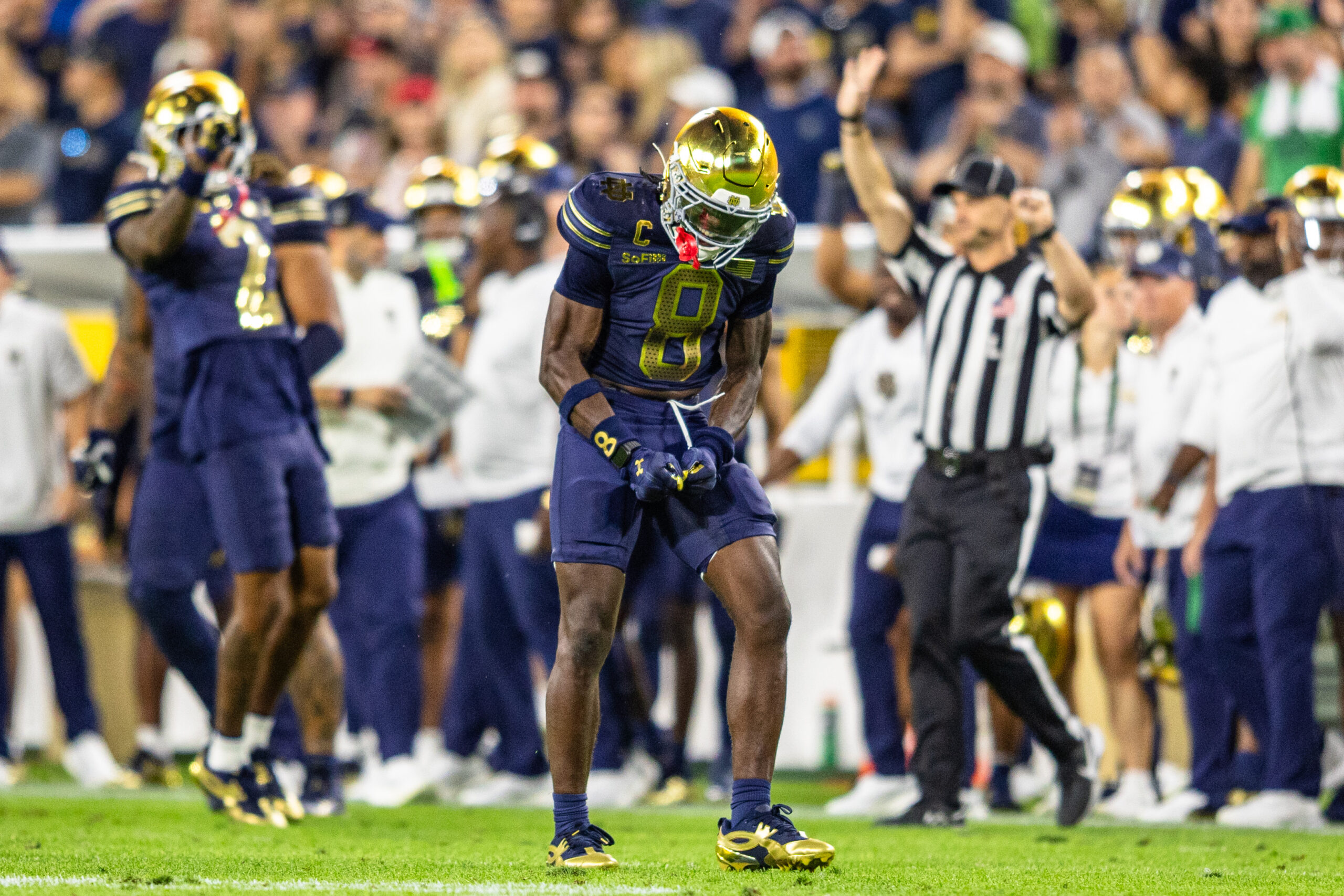
The result was a second-half offensive explosion that turned a competitive game into a convincing 41-13 Notre Dame victory at Lambeau Field.
Notre Dame scored 28 points after halftime, finding its offensive rhythm through a quartet of extended scoring drives. The Irish finally established the ground game they had been searching for, while quarterback CJ Carr settled into a groove and helped orchestrate an offense that repeatedly moved the chains.
Carr directed a nine-play, 70-yard touchdown drive before leading an eight-play, 75-yard march that also ended with a rushing touchdown from Aneyas Williams.
Those two drives were particularly important for Notre Dame after the Irish managed only 29 rushing yards in the opening half.
Williams became the centerpiece of the renewed rushing attack.
Making his first career start at running back, Williams carried 20 times for a career-best 90 yards and scored two touchdowns. With Jeremiyah Love and Jadarian Price now in the NFL after both were selected in the first round, Notre Dame entered the season facing major questions about how it would replace its dynamic backfield tandem.
Williams provided an encouraging early answer.
Nolan James also emerged as an important piece of the offense. While he saw limited opportunities as a runner, James made his biggest impact as a receiver, catching four passes for 67 yards and scoring a touchdown.
Jordan Faison added another big-play element with four receptions for 81 yards.
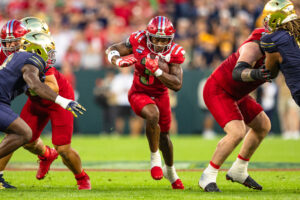
Carr finished the night 19-of-29 for 239 yards and two touchdowns, delivering the kind of efficient performance Notre Dame needed from its highly regarded young quarterback.
His first touchdown came during the opening half, when he connected with James Flanigan on a three-yard scoring pass to cap Notre Dame’s lone touchdown drive before halftime.
The Irish led 13-10 at the break, but the margin did little to reflect how difficult the first half had been.
Wisconsin consistently clogged running lanes and prevented Notre Dame from finding the space it wanted along the line of scrimmage. The Irish entered the game determined to establish the run, but the Badgers refused to cooperate.
That forced Carr and the passing game to shoulder more responsibility than Notre Dame wanted early.
Then came halftime.
Marcus Freeman’s message to his team centered on execution and eliminating the tendency to press.
“For one, I told them it was going to be a struggle,” Freeman said. “Luke Fickell-coached teams are going to fight you, they’re going to be tough. I think that first half, we were pressing a little bit. I was pressing. We did a much better job of execution after that.”
The adjustment was immediate.
Notre Dame began running the ball with greater consistency, which in turn gave Carr more favorable opportunities in the passing game.
“Being able to run the ball helped tremendously,” Freeman said. “We gave CJ a real chance to dissect what he wanted to do in the passing game.”
That balance changed the complexion of the game.
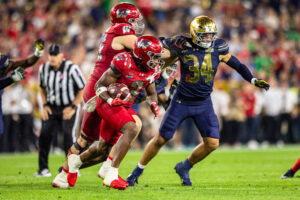
Once Williams and the Notre Dame rushing attack began finding room, Wisconsin could no longer devote as much attention to Carr. The Irish offense began sustaining drives, controlling the clock and gradually wearing down the Badgers.
Notre Dame’s defense eventually delivered the knockout blow.
Colorado transfer DJ McKinney intercepted a Wisconsin pass and returned it for a touchdown, helping turn Notre Dame’s growing advantage into a decisive one.
Wisconsin never recovered.
The Badgers had entered the night hoping to show that their program’s turnaround under Luke Fickell had arrived. For much of the first half, they looked capable of making that case.
Instead, Wisconsin was overwhelmed after intermission.
The Badgers were outscored 28-3 in the second half and struggled to regain the rhythm that had allowed them to stay within striking distance early.
For Fickell, the loss adds to the pressure surrounding his tenure. He dropped to 17-22 at Wisconsin, and the Badgers’ inability to sustain their early success against Notre Dame underscored the challenge facing the program.
Notre Dame, meanwhile, leaves Green Bay with more than just a victory.
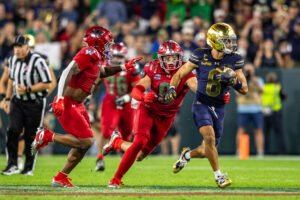
The Irish entered 2026 carrying a “leave no doubt” mentality after being left out of the College Football Playoff last season. A slow opening half certainly wasn’t the statement they envisioned, but their response provided an important early indication of what this team can become.
The revamped backfield was one of the biggest questions entering the season. After one game, Williams appears to have established himself as a leading option, while James has shown that he can impact the offense as a receiver.
There will still be plenty for Freeman and his staff to address, particularly after a first half in which the offensive line and running game struggled to consistently win at the point of attack.
But the second-half response was exactly what Notre Dame needed.
The Irish stopped pressing, established the run, opened up the passing game and finished the night by outscoring Wisconsin 28-3 after halftime.
It wasn’t a perfect performance.
It was, however, a convincing response.