
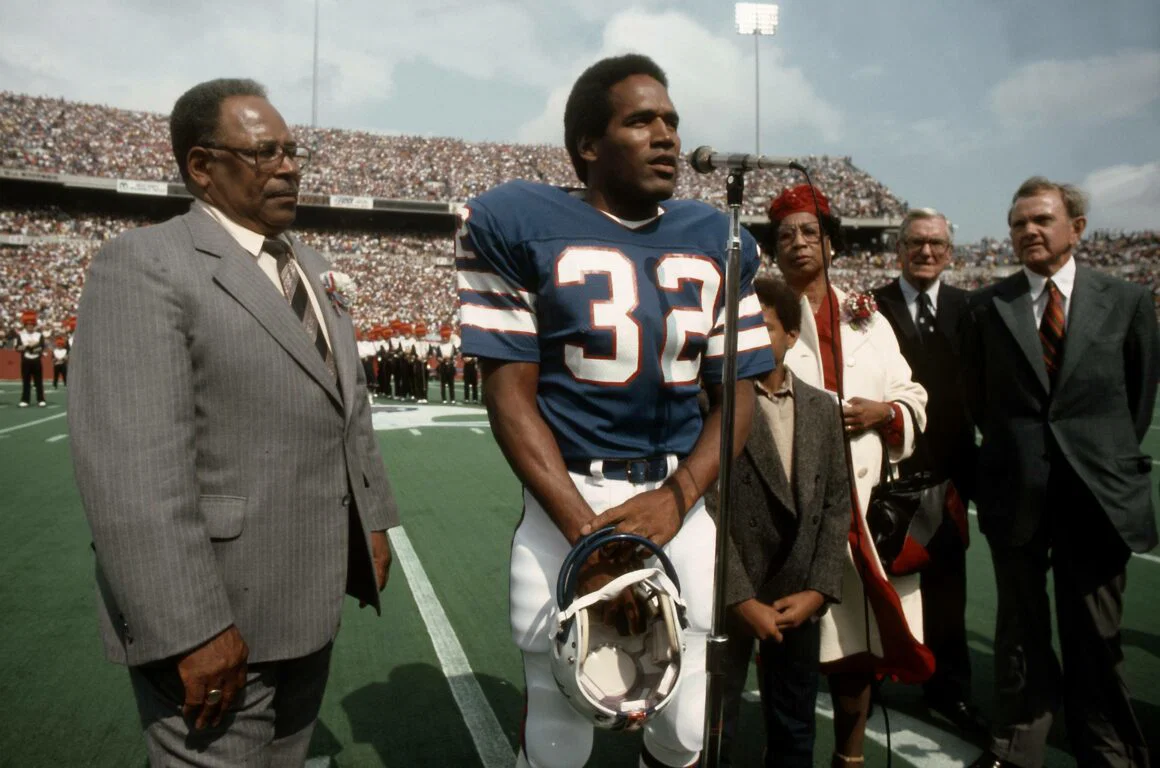
New York, NY—-Few athletes have generated as much debate as O.J. Simpson.
His name evokes two very different conversations. One centers on one of the greatest running backs to ever play professional football. The other focuses on the legal controversies and public scrutiny that defined much of his life after retirement.
The question facing sports organizations is whether those two conversations should always be inseparable.
I believe they should not.
When discussing O.J. Simpson’s place in the history of the Buffalo Bills, the focus should be on what he accomplished between the white lines.
His football résumé speaks for itself.
Simpson revolutionized the running back position during his time with the Bills. In 1973, he became the first player in NFL history to rush for more than 2,000 yards in a 14-game season, finishing with 2,003 yards—one of the greatest individual seasons the league has ever witnessed.
He was a league MVP, a five-time First-Team All-Pro, a six-time Pro Bowler, and the face of the Bills franchise throughout the 1970s. Long before Buffalo became known for its Super Bowl teams of the 1990s, O.J. Simpson gave the franchise national relevance and electrified fans every Sunday.
His accomplishments helped build the identity of the organization.
That history cannot simply be erased because later chapters of his life became controversial.
Sports organizations routinely celebrate athletic greatness.
They retire jerseys.
They build statues.
They name stadium areas after legendary players.
Those honors are intended to recognize what happened on the field—not necessarily to endorse every aspect of an individual’s personal life.
Some argue that off-the-field conduct should disqualify athletes from receiving those honors.
That is a position reasonable people can hold.
But if that becomes the standard, it raises difficult questions about where the line should be drawn.
Professional sports history includes numerous Hall of Famers and celebrated athletes whose lives included legal issues, substance abuse, domestic problems, gambling controversies, or other misconduct away from competition.
Should every one of those honors be reconsidered?
Should every stadium remove names?
Should every statue come down?
Should every Hall of Fame plaque be reevaluated?
If the answer is yes, then sports institutions would need to apply that standard consistently across generations—not selectively to a handful of individuals whose stories receive the most public attention.
Consistency matters.
The Hall of Fame has historically recognized athletic achievement.
Its mission has been to preserve football history by honoring excellence on the field.
That is why O.J. Simpson was inducted into the Pro Football Hall of Fame in 1985, nearly a decade before the criminal trial that would later dominate headlines.
His induction was based on his football career.
Nothing else.
That principle has long guided many sports halls of fame.
The statistics.
The championships.
The records.
The impact on the game.
Those accomplishments belong to history regardless of what happened afterward.
The same principle should apply when organizations evaluate how they preserve their own history.
If the Buffalo Bills decide to honor the greatest players who ever wore their uniform, O.J. Simpson’s football accomplishments deserve to be part of that conversation.
Acknowledging his place in franchise history does not require celebrating every aspect of his life.
It requires recognizing reality.
History is often uncomfortable.
Many of the greatest athletes in American sports have complicated legacies.
Ignoring those accomplishments does not change history—it simply presents an incomplete version of it.
Sports organizations are fully capable of providing context.
A display, monument, or stadium recognition can acknowledge extraordinary athletic achievements while also recognizing that an individual’s broader legacy may be viewed differently by the public.
History does not have to be sanitized to be honest.
It has to be complete.
The Buffalo Bills owe their fans an honest telling of their franchise history.
That history includes O.J. Simpson.
Not because of the controversies that followed his career.
But because of the remarkable football player he was while wearing a Bills uniform.
When evaluating athletic honors, we should begin with athletic achievement.
Records.
Performance.
Impact.
Those are the reasons athletes become legends.
Those are the reasons fans remember them.
And those are the reasons football history should continue to recognize one of the greatest players ever to step onto an NFL field.