New York, NY—-For more than three decades, Randall Cunningham has been part of one of the most fascinating debates in professional football:
Is he a Pro Football Hall of Famer?
At this point, the question should not simply be whether Cunningham was good enough.
The better question is whether the Pro Football Hall of Fame has properly valued what Cunningham accomplished at a position he helped redefine.
The evidence says it is time to take another serious look.
Cunningham was not merely a quarterback who could run when a play broke down. He was one of the NFL’s earliest truly elite dual-threat quarterbacks — a player who could beat defenses with his arm, his legs, his athleticism and his ability to extend plays.
And he was doing it at a time when quarterbacks were still overwhelmingly evaluated as traditional pocket passers.
That matters.
The Numbers Tell Only Part of the Story
Cunningham finished his NFL career with approximately 29,979 passing yards, 207 touchdown passes, 134 interceptions, 4,928 rushing yards and 35 rushing touchdowns over 161 games.
His 4,928 rushing yards were particularly remarkable.
When Cunningham retired, he was the NFL’s career leader in rushing yards by a quarterback. The Pro Football Hall of Fame itself documented that Cunningham’s 4,928 yards stood atop the quarterback rushing list before Michael Vick eventually passed him.
But Cunningham wasn’t simply accumulating rushing yards because he was a scrambling quarterback.
He was producing them while also carrying the responsibilities of an NFL starting quarterback.
That distinction is critical.
Compare Cunningham With Hall of Famer Steve Young
Perhaps the most interesting comparison is with Steve Young, a quarterback already enshrined in Canton.
Young finished his career with 33,124 passing yards and 232 touchdown passes, along with 4,239 rushing yards and 43 rushing touchdowns. He was a seven-time Pro Bowler, three-time first-team All-Pro and two-time NFL MVP.
Young clearly has the superior overall résumé.
But look at what Cunningham accomplished as a runner.
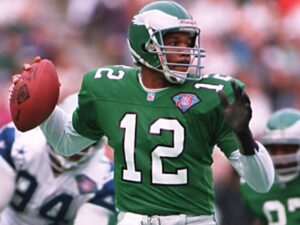
Cunningham:
- 29,979 passing yards
- 207 passing touchdowns
- 4,928 rushing yards
- 35 rushing touchdowns
- 4 Pro Bowls
Steve Young:
- 33,124 passing yards
- 232 passing touchdowns
- 4,239 rushing yards
- 43 rushing touchdowns
- 7 Pro Bowls
- 3 first-team All-Pro selections
- 2 MVP awards
The comparison doesn’t prove that Cunningham was better than Young.
It demonstrates something more important:
Cunningham’s statistical profile is unmistakably Hall of Fame-caliber in one of the most important dimensions of quarterback play — total offensive impact.
And unlike Young, Cunningham’s career was spent largely outside the offensive environment that later became commonplace for mobile quarterbacks.
The Steve McNair Comparison Is Even More Interesting
Another useful comparison is Steve McNair, who finished his career with 31,304 passing yards, 174 touchdown passes, 3,590 rushing yards and 37 rushing touchdowns.
McNair was a three-time Pro Bowler and the 2003 NFL co-MVP.
Cunningham actually accumulated more rushing yards and nearly the same number of rushing touchdowns while producing more passing touchdowns.
That does not mean Cunningham automatically belongs in Canton ahead of McNair.
It does, however, raise a legitimate question:
If the Hall of Fame recognizes quarterbacks whose value came from combining passing and rushing production, why has Cunningham’s résumé remained outside?
Cunningham Was Ahead of His Time
Statistics are important, but the Hall of Fame is supposed to preserve football history.
That is where Cunningham’s case becomes even stronger.
Today’s NFL is filled with quarterbacks who routinely make plays outside the pocket.
Josh Allen.
Lamar Jackson.
Jalen Hurts.
The modern quarterback is increasingly expected to threaten defenses with both his arm and his legs.
Cunningham was doing that decades earlier.
He wasn’t simply surviving outside the pocket.
He was creating an offensive identity around his athletic ability.
The Hall of Fame itself once described Cunningham as the quarterback who held the career rushing record before Vick passed him, illustrating just how extraordinary his rushing production was for the position.
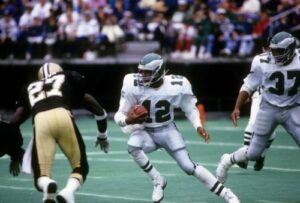
His 1998 Season Deserves More Attention
Cunningham’s 1998 season with Minnesota remains one of the most impressive quarterback seasons of his era.
He threw for more than 3,700 yards with 34 touchdown passes and only 10 interceptions while adding significant rushing production.
The Vikings went 15-1 during the regular season and reached the NFC Championship Game.
That season demonstrated that Cunningham wasn’t simply a spectacular athlete.
He could operate an explosive, high-level passing offense.
He could win from the pocket.
He could make plays outside the pocket.
And he could change the geometry of a defense simply by being on the field.
Four Pro Bowls Matter
Cunningham was selected to the Pro Bowl four times.
That is significant because the Pro Bowl was a particularly meaningful measure of quarterback recognition during much of his career.
His selections came in 1988, 1989, 1990 and 1998.
The gap between his early Eagles years and his 1998 Minnesota season is also important.
Cunningham wasn’t a one-season wonder.
He demonstrated elite ability at different points of his career and in different offensive environments.
The Biggest Argument Against Cunningham
There is a legitimate counterargument.
Cunningham does not have the traditional résumé of many quarterbacks already in Canton.
He never won an NFL MVP award.
He never won a Super Bowl.
He never made first-team All-Pro.
His career passing statistics are not in the same neighborhood as modern quarterbacks who benefited from longer careers and a dramatically more quarterback-friendly NFL.
And his playoff résumé is not overwhelming.
Those are fair criticisms.
But they should not end the discussion.
The Hall of Fame should evaluate players within the context of their era.
Cunningham played in an NFL where passing numbers were substantially lower than today’s totals. He also played a position in which running quarterbacks were not yet embraced as offensive weapons.
If today’s quarterback numbers are used as the measuring stick for a player who played primarily in the 1980s and 1990s, the comparison becomes distorted.
The Hall Has Already Shown It Can Reward Impact Beyond Raw Numbers
The recent election of Roger Craig provides another important lesson.
Craig’s career statistics alone do not tell the entire story of why he belongs in Canton.
His impact on the 49ers’ offense, his versatility, and his role in helping define an era of football became part of the larger Hall of Fame argument.
The same type of historical evaluation should be applied to Cunningham.
The 2026 Hall class included Drew Brees, Roger Craig, Larry Fitzgerald, Luke Kuechly, and Adam Vinatieri.
The Hall has repeatedly emphasized that its mission is to honor the greatest of the game and celebrate excellence.
Cunningham deserves that same examination.
This Isn’t About Putting Cunningham Ahead of Every Quarterback
This argument does not require anyone to claim Cunningham was better than Steve Young, Warren Moon, Brett Favre, Dan Marino, or other quarterbacks already in Canton.
It simply asks whether Cunningham’s total body of work meets the Hall’s standard.
And there is a compelling argument that it does.
Cunningham finished his career with more than 34,900 combined passing and rushing yards and more than 240 combined rushing and passing touchdowns.
Those numbers are remarkable when placed in historical context.
And perhaps the most important statistic is one that cannot be found in a box score:
Randall Cunningham changed what people believed a quarterback could be.
So What Does Cunningham Need to Get Into the Hall?
This is where the process becomes extremely important.
Cunningham is currently a Modern-Era candidate. For the 2026 class, the Hall listed him among 10 quarterback nominees, but he did not advance into the final stages.
Because he last played in 2001, Cunningham is approaching the point where his candidacy can move through the Hall’s Seniors pathway.
The Hall defines Senior candidates as players whose careers ended at least 25 years ago. The process is separate from the Modern-Era process.
The new Seniors process is demanding.
For the 2026 class, 162 Senior nominees were initially considered. A screening committee reduced that number to 52. The Seniors Blue-Ribbon Committee then reduced the field to 25, then nine semifinalists, before selecting three Senior finalists. Those finalists were then presented to the full Selection Committee.
For the 2026 class, the three Senior finalists were Ken Anderson, Roger Craig and L.C. Greenwood. Craig ultimately was elected.
That means Cunningham cannot simply receive enough fan support and walk into Canton.
He needs his candidacy to survive multiple levels of professional evaluation.
What Would Help Cunningham’s Case?
If Randall Cunningham wants to become a serious Seniors candidate, his supporters need to present a comprehensive historical case.
That case should include:
1. His dual-threat statistics
Not just passing numbers.
His rushing production needs to be presented alongside his passing production because that was the defining characteristic of his career.
2. Era-adjusted comparisons
Cunningham’s numbers should be compared with quarterbacks from his generation rather than today’s pass-heavy NFL.
3. His 1998 season
The Minnesota season should be central to the argument because it demonstrated that Cunningham could lead an elite offense as a passer.
4. His four Pro Bowl selections
Those selections establish that his peers and voters recognized him as one of the league’s top quarterbacks.
5. His influence on the quarterback position
This may ultimately be the most persuasive part of the argument.
Cunningham helped establish the blueprint that modern dual-threat quarterbacks would later expand upon.
6. His impact on winning
His teams, playoff appearances and ability to transform offenses need to be part of the presentation.
7. Testimony from former teammates, coaches and opponents
The Hall’s voters need to hear from people who actually experienced Cunningham.
What was it like preparing for him?
How did defenses have to change?
What did teammates believe he brought to the locker room?
How difficult was he to game-plan against?
Those testimonials can help translate statistics into football impact.
The Case Is Bigger Than Canton
There is also a historical responsibility here.
Randall Cunningham was one of the most important quarterbacks of his generation.
He was a spectacular athlete.
He had one of the strongest arms of his era.
He was an elite runner.
He played through injuries.
He reinvented himself later in his career.
And he helped open the door for a generation of quarterbacks who would eventually make dual-threat football mainstream.
The Pro Football Hall of Fame is not simply supposed to honor players with the largest statistical totals.
It is supposed to preserve the history of the game.
And when the history of the modern quarterback position is written, Randall Cunningham deserves a significant chapter.
The Bottom Line
Does Randall Cunningham have the statistical résumé of every quarterback already in Canton?
No.
Does he have the traditional résumé of a first-ballot Hall of Famer?
No.
But does he have a credible Hall of Fame case?
Absolutely.
His combination of nearly 30,000 passing yards, more than 200 touchdown passes, nearly 5,000 rushing yards, 35 rushing touchdowns, four Pro Bowls, a historic 1998 season and enormous influence on the evolution of the quarterback position makes his candidacy worthy of serious consideration.
The Hall of Fame has an opportunity to correct what many believe is an oversight.
Randall Cunningham doesn’t need nostalgia.
He doesn’t need charity.
He needs his career evaluated in its proper historical context.
And if the Seniors Blue-Ribbon Committee truly asks one question — Was Randall Cunningham one of the greatest players of his era and an important figure in the history of professional football? — there is a very strong argument that the answer should be yes.
It is time to put Randall Cunningham’s name back on the road to Canton.