
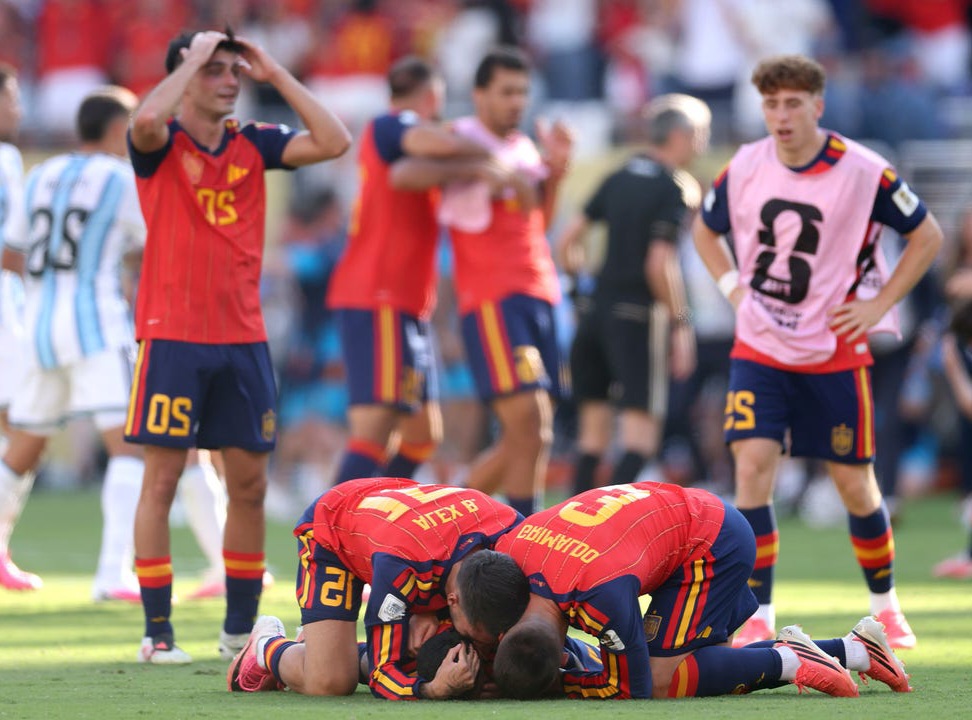
EAST RUTHERFORD, N.J. — Spain captured its second FIFA World Cup title on Sunday, defeating Argentina 1-0 in extra time before a capacity crowd at New York New Jersey Stadium to conclude the historic FIFA World Cup 2026.
The championship match remained scoreless through regulation before Spain finally broke the deadlock in the 106th minute. Ferran Torres delivered the decisive goal, lifting La Roja to its first World Cup championship since 2010 and cementing Spain’s place in history as champions of the inaugural 48-team, 104-match FIFA World Cup.
The victory also gave Spain a unique distinction, becoming the first country to simultaneously hold both the FIFA Men’s World Cup and FIFA Women’s World Cup titles.
The sold-out crowd witnessed not only a dramatic championship match but also a groundbreaking entertainment spectacle. The FIFA World Cup Topps Final Halftime Show blended football with music on a global stage, featuring performances by Madonna, Shakira, BTS, and Justin Bieber. The Chris Martin-curated production, created in partnership with Global Citizen, also included Burna Boy, conductor Gustavo Dudamel, the New York Philharmonic, the PS 22 Chorus, and Coldplay.
Spain’s dominance throughout the tournament was reflected in the individual awards announced after the final whistle. Midfielder Rodri earned the adidas Golden Ball as the tournament’s best player, goalkeeper Unai Simón received the adidas Golden Glove for his standout performances in goal, and defender Pau Cubarsí was named the tournament’s top young player with the Aramco Young Player Award.
The 2026 FIFA World Cup concluded as the most attended tournament in the competition’s history. Across 39 days of competition in Canada, Mexico, and the United States, a record 6,810,966 fans filled stadiums to witness the first World Cup jointly hosted by three nations.
The expanded tournament featured 48 national teams competing in 104 matches across 16 venues, producing 308 goals and showcasing football’s continued global growth. The championship capped a landmark edition of the tournament that established new attendance records and ushered in a new era for the FIFA World Cup.