Queens, NY—-There are moments in sports that are bigger than the scoreboard.
There are moments when you sit in a press box, look out at a court filled with thousands of people, and realize that what you are witnessing means something far beyond tennis.
For me, the 2026 U.S. Open was one of those moments.
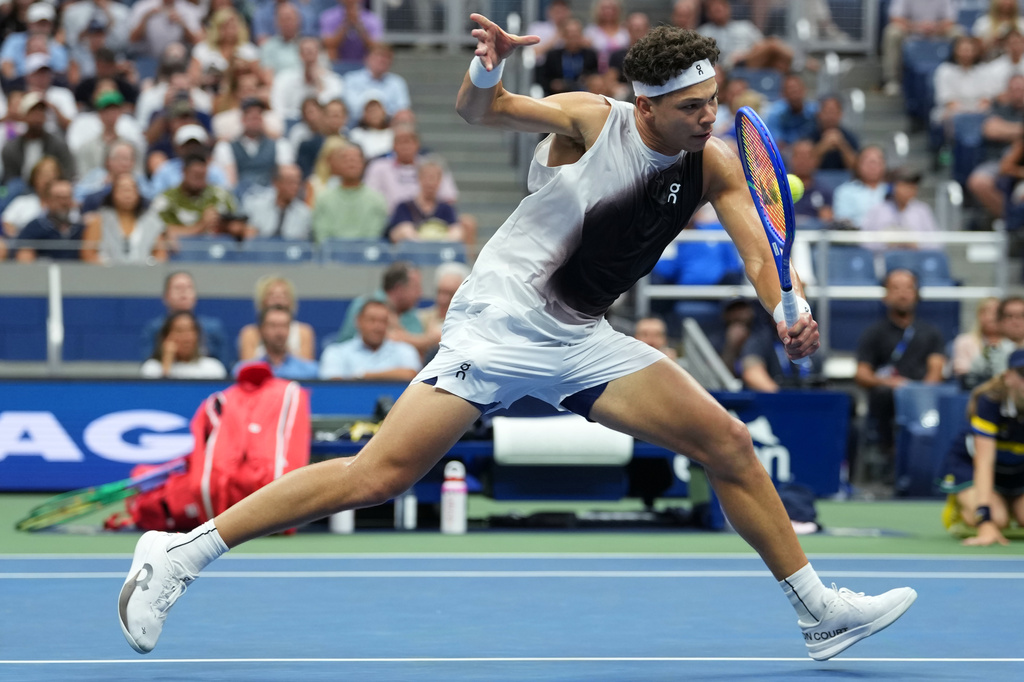
Watching Naomi Osaka, Coco Gauff, Madison Keys, Taylor Townsend, Frances Tiafoe, and Ben Shelton compete on one of the biggest stages in sports brought a tremendous sense of pride.
And as a Black sports journalist covering the U.S. Open, that pride carried another layer.
It was personal.
It was professional.
And it was symbolic.
This wasn’t simply about who won or lost.
It was about representation.
It was about history.
It was about perseverance.
And, perhaps most importantly, it was about possibility.
“It’s Possible”
Taylor Townsend may have captured the significance of this year’s U.S. Open better than anyone.
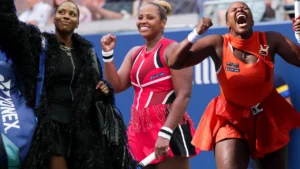
After winning the women’s doubles championship, Townsend reflected on the number of Black American players making an impact at the tournament. She talked about watching Frances Tiafoe and Ben Shelton compete and the importance of seeing Black players succeeding on tennis’ biggest stage.
“It’s been a phenomenal US Open for people of color, and just being able to show people, like, it’s possible,” Townsend said.
It’s possible.
Those words stayed with me.
Because that is what representation is really about.
It’s not simply seeing somebody who looks like you win a tennis match.
It’s seeing somebody who looks like you occupy a space that somebody may have once told you was not available to you.
A New Generation Carrying the Torch
Black excellence in tennis certainly did not begin with this generation.
We know the names that came before them.
Arthur Ashe.
Althea Gibson.
Venus Williams.
Serena Williams.
They changed the sport and created opportunities for generations that followed.
But there was something particularly powerful about watching so many Black players make their presence felt at the same U.S. Open.
Coco Gauff has already established herself as one of the biggest stars in tennis. She became a Grand Slam champion at the 2023 U.S. Open and has continued to carry enormous expectations while competing against the best players in the world.
Madison Keys represents another powerful story of perseverance. Her career has included enormous victories, difficult defeats, and years of continuing to put herself in position to succeed.
Naomi Osaka has become one of the most recognizable athletes in the world. Her impact extends beyond tennis, and her presence has helped broaden conversations about identity, representation, and what it means to be a modern athlete.
Taylor Townsend has carved out her own path, overcoming criticism and expectations about what a professional tennis player is supposed to look like or how she is supposed to carry herself.
And then there were Frances Tiafoe and Ben Shelton.
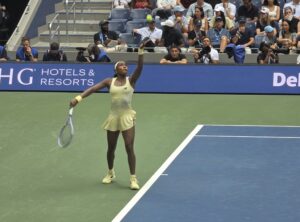
Tiafoe and Shelton Made Us Proud
Tiafoe has become one of the most recognizable personalities in American tennis.
His energy, authenticity, and willingness to embrace who he is have made him a fan favorite.
But there was something bigger happening at this year’s U.S. Open.
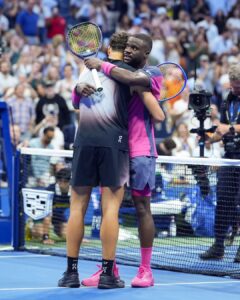
For the first time in tournament history, two Black American men met in the men’s singles semifinal.
Tiafoe and Shelton stood across the net from each other inside Arthur Ashe Stadium, with a place in the U.S. Open final on the line.
Think about that.
Two Black American men.
One of the biggest stages in tennis.
One spot in the championship match.
And when Shelton won, the significance became even greater.
Shelton became the first Black American man to reach the U.S. Open men’s singles final since Arthur Ashe in 1972.
More than five decades separated Ashe’s historic appearance from Shelton’s.
That is difficult to comprehend.
And for Black journalists watching from the press box, it was impossible not to feel pride.
We understood how difficult it is to reach a Grand Slam final.
We understood the years of sacrifice.
The travel.
The training.
The losses.
The pressure.
The expectations.
We understood that Shelton wasn’t simply walking onto a tennis court.
He was walking into history.
Pride Without Ownership
As Black journalists, we were not pretending Shelton’s accomplishment belonged to us.
It doesn’t.
He earned every point, every victory, and every opportunity.
But representation matters.
When you see someone who looks like you competing at the highest level, there is an undeniable emotional connection.
When Shelton walked onto the court for the U.S. Open final, Black fans and Black journalists around the country had every reason to feel proud.
And yes, Shelton ultimately came up short against Alexander Zverev.
But losing the final does not diminish what he accomplished.
He had already made history.
He had already done something that had not been done by a Black American man at the U.S. Open in more than half a century.
That matters.
The Other Side of the Gate
There is another part of this story that deserves to be discussed.
The athletes aren’t the only people fighting for representation.
Black journalists are fighting for representation, too.
We fight to get into the press box.
We fight for credentials.
We fight for access.
We fight to have our publications taken seriously.
We fight against assumptions about our audience, our reach and whether our organizations are supposedly “big enough” to cover major sporting events.
There are gatekeepers.
There are credential applications.
There are policies.
There are analytics.
There are people making decisions about who supposedly meets the criteria.
Sometimes you’re told there isn’t enough space.
Sometimes you’re told your publication doesn’t fit the desired profile.
Sometimes you’re told to wait.
And sometimes you’re simply told no.
But then something powerful happens.
You get the credential.
You walk through the gates.
You enter the stadium.
And suddenly, none of those explanations matter.
You’re there.

Covering the U.S. Open With Pride
That is what made covering the U.S. Open so meaningful to me.
I wasn’t watching from the outside.
I was inside.
I was working.
I was covering one of the most prestigious sporting events in the world.
And I was doing it as a Black man and a Black journalist.
With a smile on my face.
With a camera in my hand.
With a notebook ready.
With a sense of pride.
And with a sense of accomplishment that nobody can diminish.
That’s an important distinction.
Because there will always be somebody who believes they should determine whether you belong.
There will always be another credential application.
Another gatekeeper.
Another set of criteria.
Another person who thinks they should decide whether your publication is worthy of access.
But eventually, the work speaks louder than the gatekeeper.
Representation Has to Exist on Both Sides
When we talk about diversity in sports, we often focus on the athletes.
And we should.
Seeing Coco Gauff, Madison Keys, Naomi Osaka, Taylor Townsend, Frances Tiafoe, and Ben Shelton competing at the highest level matters.
Young Black boys and girls can watch them and say:
“I can do that.”
But representation has to exist on both sides of the fence.
Those same young people should also be able to look into the press box and say:
“I can be a journalist.”
“I can be a photographer.”
“I can tell these stories.”
“I can cover the U.S. Open.”
That is why access matters.
It isn’t simply about getting a credential.
It is about who gets the opportunity to tell the stories.
It is about whether independent publications are given a fair opportunity to demonstrate what they can do.
It is about whether the industry is willing to look beyond traditional definitions of who belongs.
The body of work should matter.
The professionalism should matter.
The quality of the coverage should matter.
The commitment should matter.
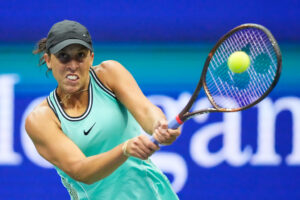
Arthur Ashe’s Legacy Lives On
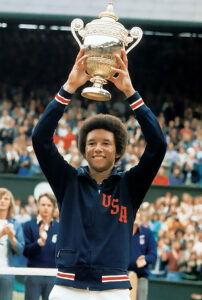
Arthur Ashe understood that representation carried responsibility.
He understood that being the first wasn’t enough.
You had to leave the door open behind you.
More than five decades later, Ben Shelton walked through that door.
Coco Gauff, Madison Keys, Naomi Osaka, and Taylor Townsend continue to carry the torch.
Frances Tiafoe continues to represent with his personality, passion and authenticity.
And every Black journalist who receives a credential, walks into a major sporting venue and tells these stories is contributing to that same larger movement.
That’s why this U.S. Open meant so much.
It wasn’t just about tennis.
It was about accomplishment.
It was about representation.
It was about history.
It was about seeing people who look like us competing, succeeding and creating moments that future generations will remember.
And for those of us who have had to deal with gatekeepers telling us that we don’t meet the criteria, there is something incredibly satisfying about standing inside the stadium anyway.
You don’t have to argue.
You don’t have to explain.
You don’t have to ask for validation.
You simply do the work.
You cover the event.
You tell the story.
You take the photograph.
You file the article.
And you smile.
Because you know what it took to get there.
And once you’re there, nobody can diminish that accomplishment.
It’s Possible
That’s the message I hope young Black athletes, young Black journalists and young Black professionals take from this U.S. Open.
It’s possible.
It’s possible to overcome expectations.
It’s possible to challenge stereotypes.
It’s possible to compete on the biggest stage.
It’s possible to win championships.
It’s possible to make history.
It’s possible to walk through doors that people once told you were closed.
And it’s possible to do it while carrying pride in who you are.
The U.S. Open gave us plenty to celebrate this year.
But for me, the greatest takeaway was bigger than any one result.
It was seeing Black excellence on the court — and experiencing the pride of being a Black journalist fortunate enough to be there to document it.
Arthur Ashe opened the door.
Serena and Venus pushed it wider.
Now Gauff, Keys, Osaka, Townsend, Tiafoe, and Shelton are showing the world what is possible when the next generation refuses to accept limitations.
The door is open.
And we belong on both sides of it.
It’s possible.